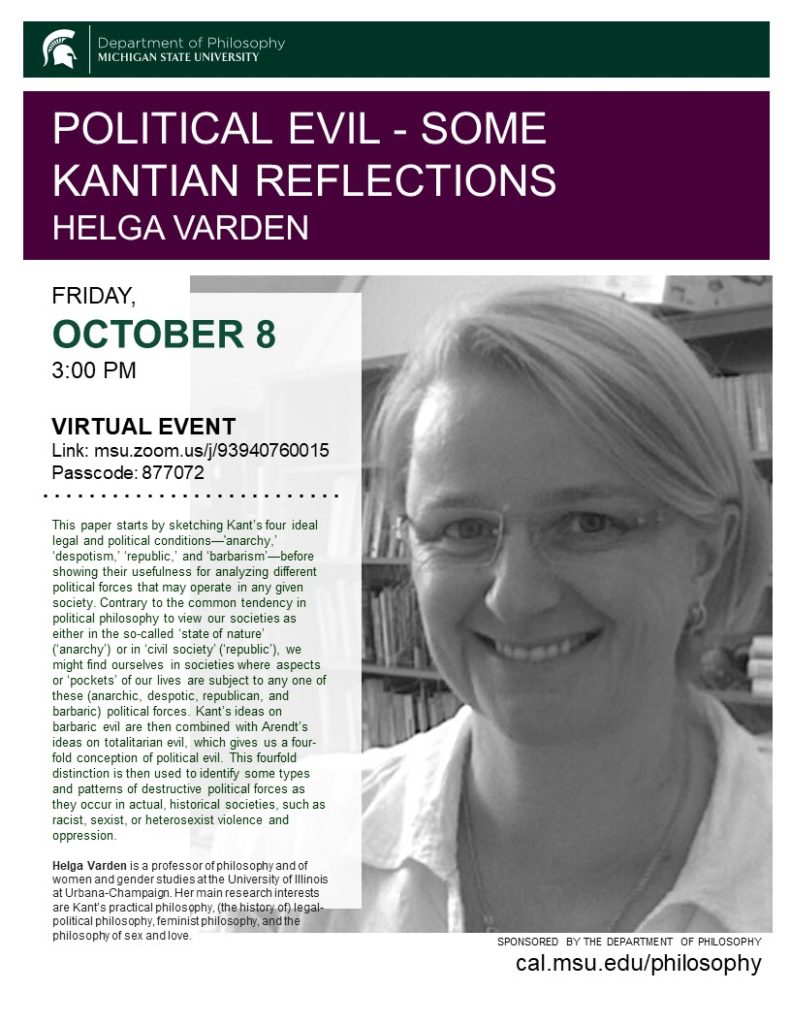
Political Evil: Some Kantian Reflections
This paper starts by sketching Kant’s four ideal legal and political conditions—’anarchy,’ ‘despotism,’ ‘republic,’ and ‘barbarism’—before showing their usefulness for analyzing different political forces that may operate in any given society. Contrary to the common tendency in political philosophy to view our societies as either in the so-called ‘state of nature’ (‘anarchy’) or in ‘civil society’ (‘republic’), we might find ourselves in societies where aspects or ‘pockets’ of our lives are subject to any one of these (anarchic, despotic, republican, and barbaric) political forces. Kant’s ideas on barbaric evil are then combined with with Arendt’s ideas on totalitarian evil, which gives us a four-fold conception of political evil. This fourfold distinction is then used to identify some types and patterns of destructive political forces as they occur in actual, historical societies, such as racist, sexist, or heterosexist violence and oppression.
Helga Varden is a professor of philosophy and of women and gender studies at the University of Illinois at Urbana-Champaign. Her main research interests are Kant’s practical philosophy, (the history of) legal-political philosophy, feminist philosophy, and the philosophy of sex and love.